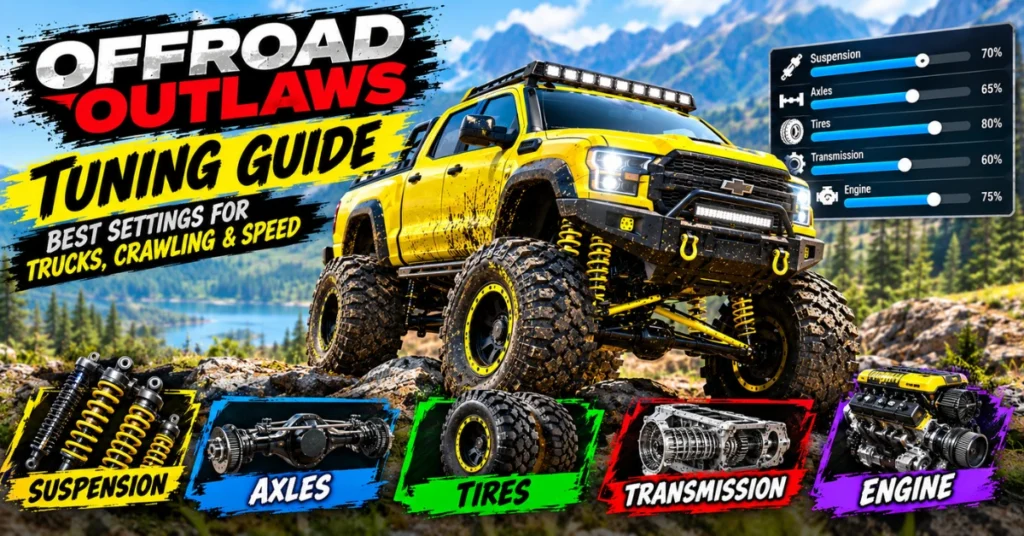
Offroad Outlaws Tuning Guide: Best Settings for Trucks, Crawling & Speed
The best Offroad Outlaws tuning setup depends on what you want your vehicle to do. A rock crawler needs controlled low speed movement and enough suspension travel to handle uneven obstacles, while a truck built for fast trails needs a different balance of stability, suspension response and gearing.
This Offroad Outlaws tuning guide explains suspension stiffness, damping, travel, gear ratios, tires, axles and engine upgrades. It also covers starting setups for different driving styles and practical ways to fix bouncing, poor traction, slow climbing and unstable handling.
There is no single tune that works perfectly for every vehicle. Use the guidance below as a starting point, then adjust individual settings to suit your vehicle, available upgrades and terrain.
How to Tune Your Vehicle in Offroad Outlaws?
To tune a vehicle in Offroad Outlaws, open your vehicle customization or tuning options and adjust the suspension, axle setup, tires and transmission where those options are available. The exact controls depend on the vehicle and installed parts.
The most effective approach is to start with the problem you want to solve instead of changing every setting at once.
Offroad Outlaws officially supports suspension tuning, axle selection, engine upgrades and other vehicle customization options. Not every vehicle offers the same setup possibilities.
Offroad Outlaws Suspension Tuning Explained
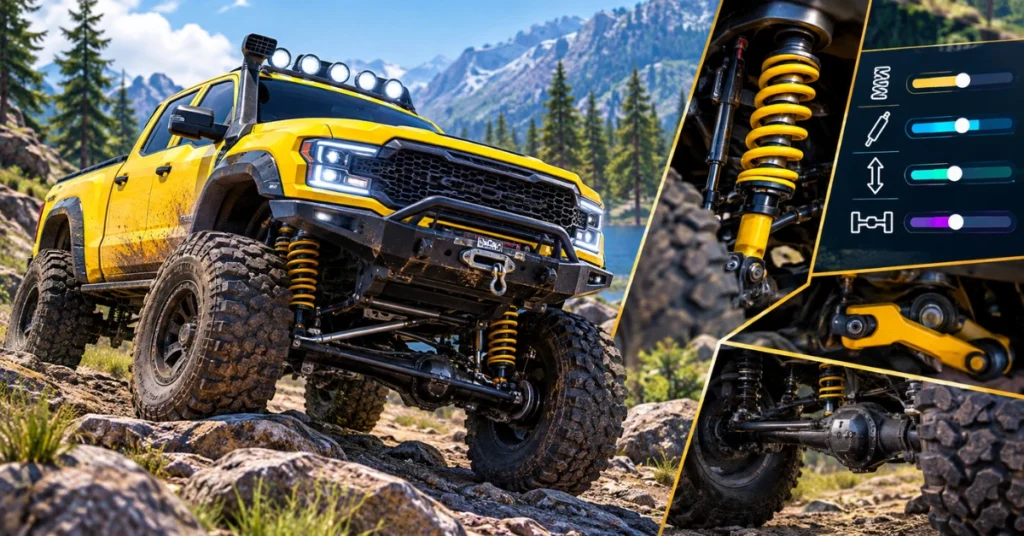
Suspension tuning affects how your vehicle moves over uneven terrain, maintains tire contact and responds to bumps. Before choosing specific values, it helps to understand what each control changes.
Stiffness
Stiffness affects how much the suspension resists compression. Its ideal setting depends on the vehicle’s weight, suspension type, ride height and intended use.
Do not assume that the lowest stiffness always produces the best crawler. The right balance depends on the rest of the setup.
Damping
Damping controls how quickly the suspension responds to movement. It is particularly important when a vehicle continues bouncing after a bump or feels too rigid over uneven terrain.
Change damping in small increments and test on the same terrain. Excessively high or low values can both produce undesirable handling. Build your dream offroad machine with the best Offroad Outlaws Car Mods, custom upgrades and pro tuning tips!
Suspension Travel
Suspension travel determines how far the suspension can move. More available travel can help a wheel follow uneven ground but maximum travel alone does not guarantee good handling. For rock crawling, more travel may help keep tires in contact with rocks and uneven surfaces.
For a speed focused build the goal is to combine sufficient travel with controlled body movement. If your suspension bottoms out, inspect available travel, ride height, stiffness and the installed suspension type together.
Front and Rear Suspension Settings
The front and rear of a vehicle do not always need identical settings. Weight distribution, wheelbase, steering behavior and the installed parts can change how each end responds.
For example, if the front end drops excessively while climbing, inspect the front suspension and vehicle balance before changing every setting. If the rear bounces after landing, focus on the rear suspension’s response.
Start with similar front and rear values when you have no baseline, then adjust each end according to its behavior. Trouble playing? Discover quick and easy Offroad Outlaws fixes to solve crashes, loading errors and connection problems!
Axle Width and Suspension Type
Axle selection and width can affect the vehicle’s stance, clearance and handling. The available options vary by build.
The game’s official description identifies multiple axle and suspension customization options so check what your particular vehicle supports before following a setup intended for another build.
Best Offroad Outlaws Tuning Settings for Different Builds
There is no single set of numbers that is best for every vehicle. The following recommendations are starting approaches based on the driving goal, not guaranteed presets tested on every current game build.
| Build type | Recommended starting approach | Main priority |
| All around truck | Balanced stiffness, moderate damping and practical tire size | Versatility |
| Rock crawler | Ample usable travel, controlled damping and suitable low gearing | Traction and obstacle clearance |
| Mud truck | Suitable tires, adequate clearance and gearing that avoids excessive wheelspin | Maintaining momentum |
| Trophy truck or trail build | Suspension travel with enough control for bumps and turns | Stability at speed |
| Speed or drag build | Stable ride height, appropriate tires and gearing suited to the track | Acceleration and speed |
Best All Around Truck Tune
An all around setup should be capable of handling ordinary trails without being optimized so heavily for one task that it becomes difficult to use elsewhere. Start with a moderate ride height, balanced suspension stiffness and enough damping to control repeated movement.
Choose tire dimensions that provide useful clearance without making the vehicle unnecessarily difficult to control. Keep the gearing reasonably versatile. If the truck climbs well but struggles on open trails, revisit the transmission instead of rebuilding the entire suspension.
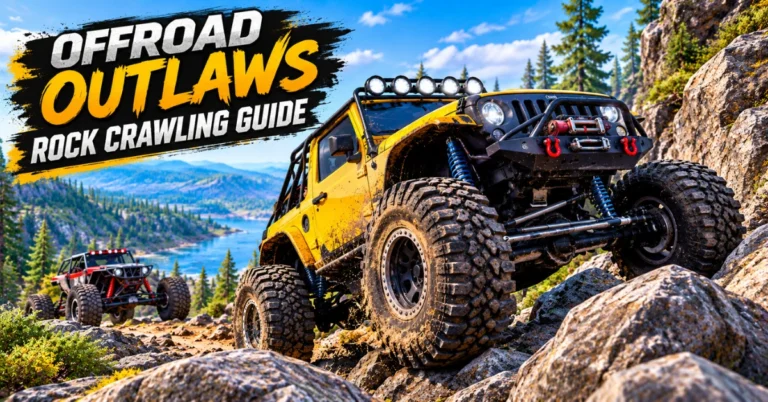
Conquer the toughest trails with Offroad Outlaws Rock Crawling builds, pro settings and expert driving tips!
Best Rock Crawling Tune
Rock crawling requires controlled movement over steep, uneven obstacles. Prioritize low speed control, tire contact and clearance beneath the vehicle.
Community examples illustrate how much crawler setups can vary. One player shared a crawler setup with stiffness around 7,860, maximum travel and damping around 2,045 another older discussion suggested a different range. These are individual player recommendations, not official settings or independently verified current game results.
Best Mud Truck Tune
Mud driving requires a balance between traction, clearance and maintaining momentum. A setup that works well on solid rocks may not work equally well in soft mud. Choose tires appropriate for the terrain and avoid making the vehicle so tall or top heavy that it becomes difficult to control.
Use gearing that lets the engine maintain useful power without making the wheels spin excessively. If the vehicle loses momentum, check whether the tires are spinning, the gearing is too tall for the situation or the vehicle is losing ground clearance. Each problem calls for a different adjustment.
Best Trophy Truck and Trail Tune
A trail or trophy truck build needs to handle uneven ground without becoming unstable when speed increases. Start with sufficient suspension travel and enough stiffness to support the vehicle. Set damping so the vehicle settles after bumps rather than continuing to oscillate.
Test on a route containing both bumps and turns. If the vehicle performs well on straight sections but becomes unstable in corners, reassess the overall stance, ride height and suspension balance.
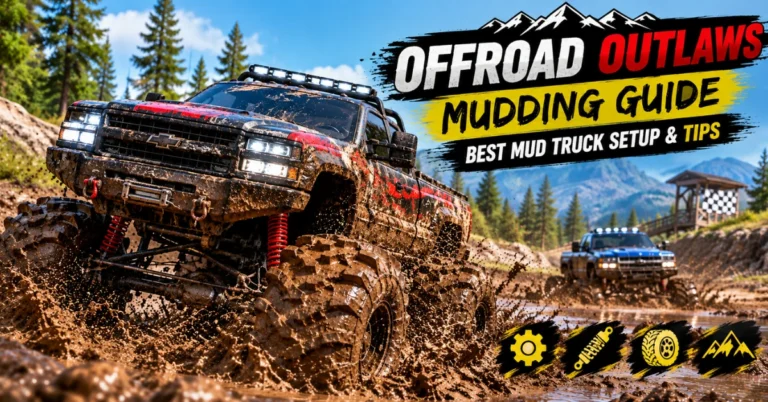
Dominate muddy trails with the best Offroad Outlaws Mudding setups, mud truck builds and winning tips!
Best Speed and Drag Racing Tune
Speed focused builds require a different approach from crawlers. The goal is to reduce unnecessary instability while choosing gear ratios that suit the track and engine. For drag racing, focus on acceleration and the ability to use the available power effectively. For a longer track, higher gears may need to support a higher top speed.
Use a consistent test track. A tune that performs well on a straight road may not be ideal on a course with turns, uneven ground or frequent elevation changes. A community discussion about racing builds also emphasizes testing on the intended track and adjusting gearing to match the course.
Offroad Outlaws Gear Ratio Tuning Guide
Gear ratios determine how engine power is translated into wheel rotation. In general, shorter gearing favors acceleration and controlled low speed movement, while taller gearing can support higher speeds when the engine has enough power to pull it.
The best values depend on the vehicle, engine, tire size, transmission and driving conditions. Unlock peak performance with Offroad Outlaws Tuning tips for better speed, control and unbeatable truck setups!
What Gear Ratios Do
Offroad Outlaws provides gear tuning for supported vehicles. You may see a low gear and individual forward gears.
A higher numerical ratio generally provides more torque multiplication at the wheels but less speed at a given engine RPM. A lower numerical ratio generally favors speed but can reduce wheel torque. The result also depends on the transmission and available engine power.
Best Gear Ratios for Rock Crawling
Rock crawling prioritizes controlled movement rather than maximum speed. Start with a relatively low crawl gear and close enough ratios that the vehicle can continue climbing without losing too much engine power when shifting. One community posted manual crawling example uses the following values:
| Gear | Example ratio |
| Low | 4.0 |
| First | 3.6 |
| Second | 3.0 |
| Third | 2.3 |
| Fourth | 1.8 |
| Fifth | 1.5 |
Source: a player submitted technical crawling gear setup. These values are an illustrative starting point from a community post, not a verified universal tune.
If the vehicle struggles to climb, try a lower speed gear or adjust the low ratio. If it moves too quickly to control over obstacles, make the crawl gearing more suitable for slow movement.
Gear Ratios for Acceleration and Top Speed
A vehicle can accelerate quickly but reach its maximum speed early or accelerate slowly while continuing to gain speed over a longer distance. To improve acceleration:
To improve top speed:
If a vehicle cannot reach the engine’s useful power range in a tall gear, reducing the ratio further may make it slower rather than faster.
Manual vs. Automatic Transmission
Manual transmission gives you more direct control over gear selection. It can be useful for technical crawling because you can hold a suitable gear instead of allowing an automatic shift to interrupt controlled movement.
Automatic transmission may be more convenient for general trail driving and racing, depending on the vehicle and setup. Neither option is automatically faster in every situation. Choose the transmission that helps you maintain control, then tune the ratios around that choice.
Best Tires, Wheels, Axles and Engine Upgrades
Tuning works best when the supporting parts suit the same driving goal. Increasing engine power will not automatically fix poor traction and fitting the largest tires will not always improve overall performance.
Tire Size and Width
Larger tires can improve ground clearance, helping the vehicle clear rocks and other obstacles. However, they may also make the vehicle harder to accelerate or control if the gearing and suspension are not adjusted accordingly. Tire width and tire type can also affect how the vehicle behaves on different surfaces.
Choose a setup that suits the terrain rather than automatically maximizing every tire setting. For crawling, prioritize useful clearance and consistent tire contact. For speed focused builds, prioritize predictable handling and appropriate gearing.
Axles and Drivetrain
Check the axle options available for your vehicle before choosing a setup. Axle type can affect clearance, fitment and the way the build behaves. Do not assume a particular axle is best for every vehicle. A configuration that works for a dedicated crawler may be unsuitable for a different vehicle or racing build.
Engine Upgrades
Engine upgrades can improve available power but the result depends on how the rest of the vehicle is configured. If your upgraded truck accelerates poorly, inspect the gear ratios and tire size before spending more on engine parts. If the engine produces enough power but the tires continually lose traction, more power alone may not solve the problem.
The official game description confirms that Offroad Outlaws includes engine upgrades and drivetrain customization. The precise options depend on the vehicle and available parts.
How to Fix Common Offroad Outlaws Tuning Problems?
When a vehicle handles poorly, identify the symptom first. Several different settings can cause similar problems so change one relevant variable at a time.
| Problem | What to check | Adjustment to try |
| Truck keeps bouncing | Damping, stiffness and travel | Adjust damping gradually and retest |
| Vehicle tips over | Ride height, stance and suspension balance | Lower the setup if appropriate or improve stability |
| Tires spin without traction | Tire choice, throttle and gearing | Reduce excessive wheelspin and reassess the gearing |
| Truck struggles on steep rocks | Low gear, clearance and tire contact | Use suitable low gearing and inspect ground clearance |
| Vehicle accelerates slowly | Gear ratios, tire size and engine upgrades | Check lower gears and whether the engine can pull the setup |
| Vehicle becomes unstable at speed | Ride height, damping and suspension balance | Reassess stability and test at increasing speeds |
| Suspension bottoms out | Travel, ride height and suspension type | Check available travel and the overall setup |
Why Does My Truck Keep Bouncing?
Repeated bouncing may indicate that damping is not suited to the suspension setup. Stiffness, travel and ride height can also contribute to the behavior.
Start by adjusting damping in small increments. Test on the same bump or uneven section and observe whether the vehicle settles more predictably. Avoid changing stiffness and damping simultaneously or it will be harder to identify what helped.
Why Does My Vehicle Tip Over?
Excessive ride height, a narrow stance or an unsuitable suspension balance can make a vehicle more difficult to control on slopes and turns. Try reducing ride height if clearance allows, checking axle width and slowing down through turns. A wider stance may help but the best configuration depends on the vehicle and the obstacles it needs to clear.
Why Do My Tires Spin Without Moving Forward?
Wheelspin means the tires are rotating without producing enough forward movement. Possible causes include poor traction, excessive throttle, unsuitable gearing or a loss of tire contact.
Try applying power more gradually. If the vehicle is climbing, use a suitable low gear. If the tires still spin, inspect the tire setup and whether the suspension is allowing the wheels to follow the terrain.
Why Is My Truck Slow After Installing Bigger Tires?
Larger tires can increase effective gearing at the wheel, making acceleration more difficult with the same transmission ratios. Check whether the engine can pull the current gearing. You may need to adjust the lower gears or reconsider tire diameter. Do not assume that larger tires automatically make a vehicle better at crawling.
Why Does My Suspension Bottom Out?
Bottoming out occurs when the suspension reaches the limit of its available movement. Check travel, ride height and the installed suspension type. Increasing ride height may help with clearance but excessive height can introduce stability problems.
If the issue occurs mainly during fast driving, inspect the entire setup rather than maximizing suspension travel without considering control.
How to Test and Improve Your Tune?
A reliable tuning process is more useful than repeatedly copying settings from different vehicles. Use the following checklist whenever you change a build.
Avoid changing every setting to its maximum just because the option is available. A useful tune balances the vehicle’s capabilities with the terrain you actually drive.
Conclusion
The best Offroad Outlaws tuning setup is the one that matches your vehicle, upgrades and driving goal. Start with suspension and tire setup, adjust your gear ratios and use repeatable tests to identify what improves performance. For more game information and related guides, visit the Offroad Outlaws MOD APK page or explore the Offroad Outlaws Money Guide if you need help with in game progression.