Offroad Outlaws Rock Crawling Guide: Best Builds, Settings & Tips
Rock crawling in Offroad Outlaws is all about getting over steep rocks, uneven trails and difficult obstacles without losing traction or getting your vehicle stuck. A good crawler needs more than a powerful engine. Suspension balance, tire setup, ground clearance, gearing and careful throttle control all affect how well it handles rocky terrain.
The best setup depends on your vehicle and the type of obstacles you want to climb. A dedicated crawler buggy may suit technical rock sections, while a modified truck can provide a useful balance of climbing ability and stability. This guide explains how to choose a crawler, adjust its settings, improve your driving technique and troubleshoot common problems.
What Is Rock Crawling in Offroad Outlaws?
Rock crawling is a slow speed offroad driving style focused on crossing rocky obstacles and climbing steep, uneven surfaces. Instead of relying on speed, you need controlled movement, good tire contact, sufficient clearance and suspension that allows the wheels to follow the terrain.
Offroad Outlaws supports vehicle customization and suspension tuning, allowing players to adjust their vehicles for different driving conditions. Its Map Maker also provides opportunities to explore or create challenging trails.
Rock crawling differs from mudding and high speed offroading. In mud, maintaining momentum can be important. On rocky terrain, too much throttle can cause wheelspin, while poor vehicle positioning can leave the chassis resting on a rock.
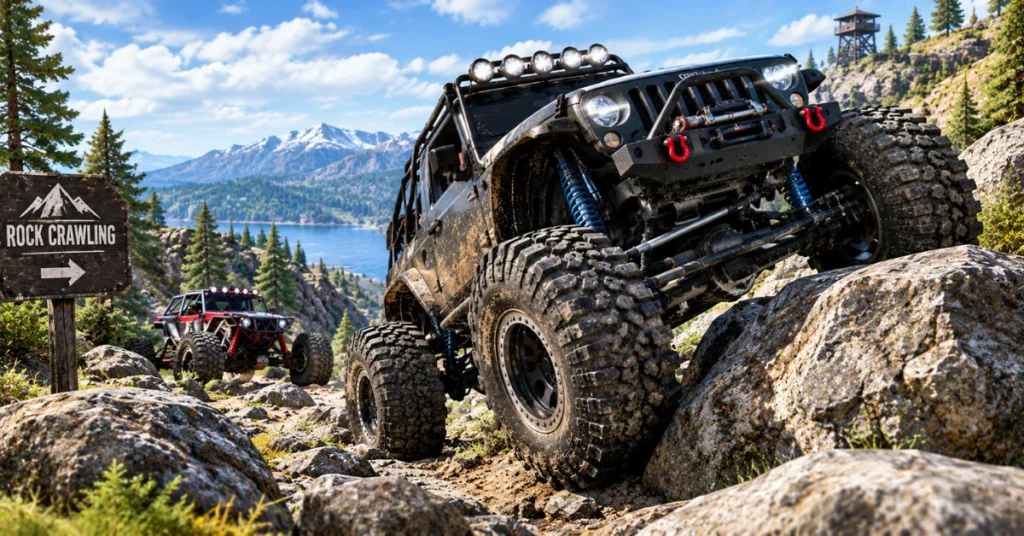
The goal is to move steadily while keeping the vehicle balanced and maintaining as much useful tire contact as the terrain allows.
Best Vehicles for Rock Crawling in Offroad Outlaws
There is no single vehicle that is best for every rock crawling situation. The right choice depends on the obstacles, the vehicle’s geometry and how much customization you want to do.
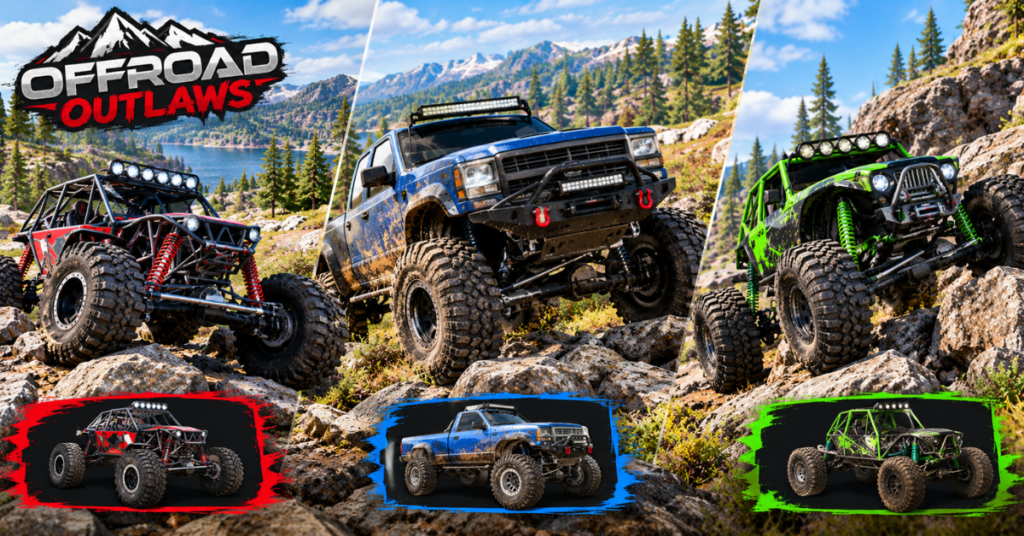
Dedicated crawler buggy
A dedicated crawler buggy is worth considering for technical climbs and uneven rock formations. Its suitability depends on the available model, suspension configuration, wheelbase and overall setup.
Look for a vehicle that can maintain wheel contact, clear obstacles without repeatedly catching its chassis and remain stable on uneven surfaces.
Modified offroad truck
A modified truck can be a good starting point if you want to build a crawler using a familiar vehicle platform. Suspension, tire, gearing and steering adjustments can improve its climbing ability.
However, adding larger tires and more suspension travel does not automatically make a truck better. Body shape, wheelbase, weight distribution and stability can still limit its performance.
Rock bouncer
A rock bouncer style build may suit aggressive climbs and obstacles where greater power and clearance are useful. However, a setup designed for steep climbing may not be ideal for slow, technical sections that require precise wheel placement.
Which should you choose? Start with a vehicle that has a suitable wheelbase, enough clearance and a suspension configuration you can tune. Improve its weaknesses before spending money on upgrades that may not address the actual problem.
Best Offroad Outlaws Rock Crawling Settings
A useful crawler setup balances suspension movement, stability, traction and controlled power delivery. Rather than maximizing every setting, adjust the vehicle according to how it behaves on the rocks.
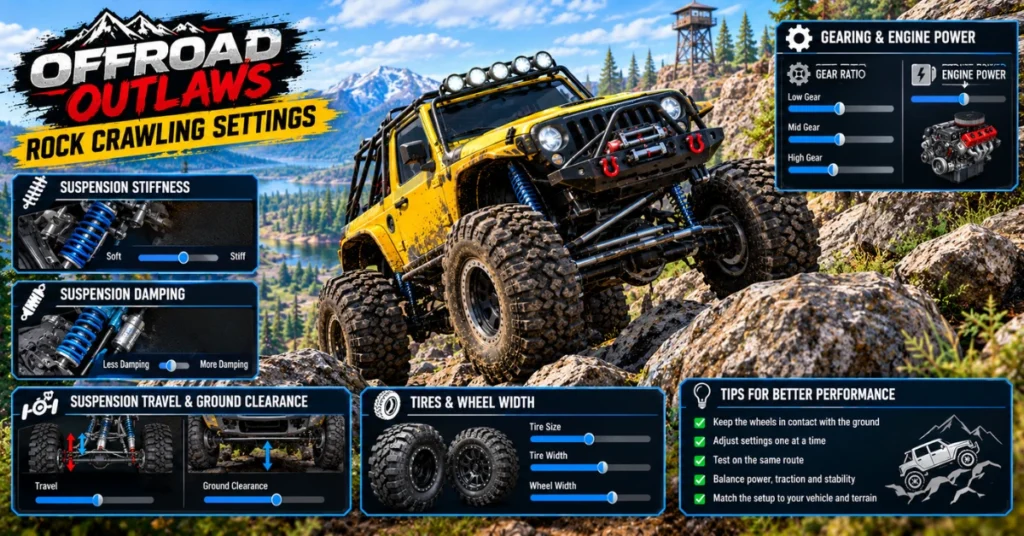
Suspension stiffness
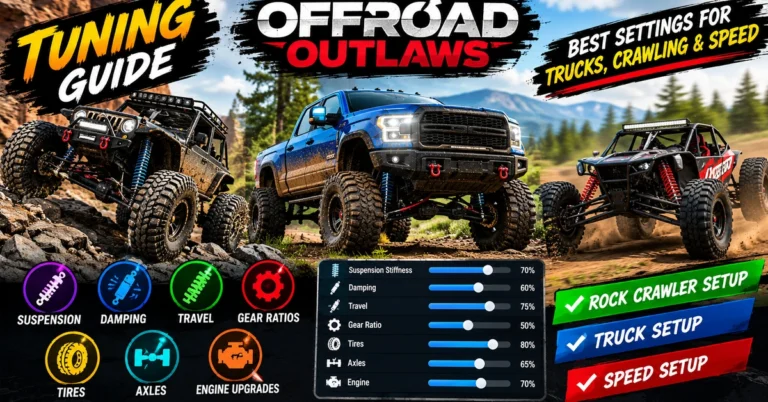
Stiffness affects how readily the suspension moves under load. A softer setup may allow more suspension movement over uneven terrain, while a stiffer setup can help control body movement.
Neither extreme is automatically best. If the vehicle struggles to keep its wheels in contact with uneven rocks, investigate whether its suspension can move appropriately. If it leans excessively or feels unstable, review stiffness alongside ride height and vehicle geometry.
Suspension damping
Damping influences how quickly suspension movement is controlled. An unsuitable damping setup can contribute to excessive bouncing or poorly controlled movement. If your crawler continues bouncing after an obstacle, adjust damping gradually and repeat the same climb. Change one variable at a time so you can identify whether the adjustment helps.
Suspension travel and ground clearance
Suspension travel affects how far the suspension can move, while ground clearance determines how much room there is beneath the vehicle. Both matter but they are not interchangeable. More travel does not necessarily guarantee greater clearance or better climbing performance.
If the chassis repeatedly catches on rocks, inspect the ride height, suspension configuration, vehicle shape and approach angle. If a wheel loses contact with the ground, investigate suspension movement and the route across the obstacle.
Tires and wheel width
Tires affect traction while tire size and wheel dimensions can also influence clearance and vehicle handling. Larger tires may help a vehicle clear certain obstacles, but they are not always the best choice for every build. Wider wheels or tires can also change the vehicle’s proportions and behavior.
Choose a setup that suits your vehicle and the terrain. If your tires spin without moving the vehicle forward, investigate throttle input, gearing and wheel contact before assuming that larger tires will solve the problem.
Gearing and engine power
Low speed control is especially important when climbing steep rocks. A suitable low gear can help the vehicle move more gradually and make it easier to manage throttle input.
If your crawler surges forward or struggles to maintain slow movement, review its gear ratios. Engine power may help in some situations but more power will not fix inadequate traction, poor clearance or an unsuitable approach.
Example Rock Crawler Settings
Community discussions contain several different crawler configurations. These can provide starting points but they should not be treated as verified settings for every vehicle or current game version.
One community reported truck setup from 2026 used the following front and rear values:
Setting | Front | Rear |
Damping | 5,200 | 5,200 |
Stiffness | 15,700 | 15,200 |
Travel | 48 | 50 |
Axle width adjustment | 0.12 | 0.13 |
Wheel radius | 1.5 | 1.5 |
The same discussion reported a wheel width value of 2.0 for the rear setup. These values reflect a player reported configuration, not an independently verified optimal build. Menu units, vehicle compatibility and results may vary.
Use an example like this as a reference rather than copying it blindly. Start with a suitable vehicle, test it on a repeatable obstacle and adjust the settings that correspond to its actual problems.
How to Rock Crawl in Offroad Outlaws?
A well tuned vehicle still needs the right approach. Careful driving can help you overcome obstacles that would otherwise cause wheelspin, tipping or chassis hang ups.
1. Approach the obstacle carefully
Look at the shape of the rock before driving into it. Identify a route that gives the tires a reasonable chance of maintaining contact without placing the chassis directly against a large obstruction.
Avoid attacking every rock face straight on. A different approach angle may help the vehicle climb without catching its underside.
2. Use smooth throttle control
Applying too much throttle can cause the tires to spin, especially when the vehicle has limited grip or is already struggling to climb. Use gradual inputs and pay attention to how the vehicle responds. If the tires spin without making progress, reduce throttle and reassess the gear, traction and wheel placement.
3. Keep the vehicle balanced
Uneven terrain can shift the vehicle’s weight and make it lean or tip. Avoid abrupt steering and acceleration when crossing narrow or uneven sections. If one side begins lifting, pause if the situation allows and consider whether a different route would keep the vehicle more stable.
4. Choose gears for control
A lower gear can be useful when you need to move slowly over a difficult section. The appropriate ratio depends on the vehicle and its gearing configuration. Do not assume that the lowest possible gearing is always ideal. If the vehicle becomes difficult to control or the wheels continue spinning, reassess the gear ratios and throttle input.
5. Recover instead of forcing the climb
If the chassis is resting on a rock or the vehicle is positioned awkwardly, repeatedly applying more throttle may not help. Back away if possible, change your approach or reposition the vehicle. A small change in the route can sometimes solve a problem that additional engine power cannot.
How to Make Your Crawler Climb Steeper Rocks?
Steep climbs put several parts of a vehicle’s setup to the test. The right approach depends on the obstacle but the following factors are worth checking.
Ground clearance: If the chassis hits the rock before the tires can climb it, review the ride height, vehicle shape and approach angle.
Wheelbase: Vehicle length affects how the vehicle approaches changes in slope. A longer wheelbase can help in some situations but may make certain transitions more difficult. The best balance depends on the obstacle.
Suspension articulation: The suspension needs to accommodate uneven surfaces so the wheels can maintain useful contact. Excessive body movement, however, can make the vehicle harder to control.
Gearing: A suitable gear ratio can help maintain controlled movement on a steep incline. Review the gearing if the vehicle surges or struggles to crawl slowly.
Throttle control: Apply power gradually and avoid unnecessary wheelspin. A more powerful engine is not a substitute for traction or suitable vehicle positioning.
If your crawler can climb one steep wall but struggles with another, do not immediately replace the entire setup. Compare the obstacles and identify whether clearance, stability, gearing or wheel contact is causing the difference.
Common Rock Crawling Problems and How to Fix Them
The quickest way to improve a crawler is to diagnose what prevents it from moving rather than changing several settings at once.
Problem | What to check | What to try |
Tires spin without progress | Throttle, gearing and wheel contact | Reduce throttle, try a suitable lower gear and reassess the route |
Chassis gets stuck on rocks | Ground clearance and approach angle | Change the approach or review ride height and vehicle geometry |
Truck tips backward | Slope, acceleration and vehicle balance | Use smoother throttle and reconsider the climbing line |
Vehicle rolls sideways | Uneven terrain, body movement and wheel placement | Choose a more stable route and review the setup |
Suspension bounces excessively | Damping and stiffness balance | Adjust damping incrementally and retest |
A wheel loses ground contact | Suspension movement and obstacle positioning | Try a different line and review the suspension configuration |
Powerful engine but poor climbing | Traction, clearance and gearing | Diagnose the underlying limitation before adding power |
Setup works on one map but fails on another | Differences in obstacle shape and terrain | Adapt the setup and driving approach to the new route |
These are starting points for diagnosis, not guaranteed one setting fixes. Several factors can produce the same symptom so the test changes individually.
How to Test and Improve Your Rock Crawler?
A repeatable test helps you determine whether a tuning change actually improves your vehicle.
If a change improves one climb but makes another harder, decide which type of terrain matters most for your build. A specialized crawler may perform better in its intended conditions than a vehicle configured to handle every off road activity.
Rock Crawling vs. Mudding and Hill Climbing
These driving styles have different priorities, even though some vehicle setups can overlap.
Driving style | Main challenge | Main priority |
Rock crawling | Uneven rocks and technical obstacles | Controlled movement, wheel contact and clearance |
Mudding | Soft, slippery or deep mud | Traction and suitable momentum |
Hill climbing | Steep inclines and changes in slope | Controlled power delivery, grip and stability |
A setup that works well in mud may not be ideal for technical rocks. Likewise, a crawler tuned for slow, precise climbing may not be the best choice for high speed driving.
Conclusion
Successful rock crawling in Offroad Outlaws comes down to a balanced vehicle and controlled driving. Choose a suitable crawler, adjust its suspension and gearing carefully, maintain useful tire contact and avoid forcing the vehicle through obstacles it cannot clear.
Start with a simple build, test it on the same rocky section and change one setting at a time. This approach helps you understand what works for your vehicle instead of relying on a single setup that may not suit every climb.